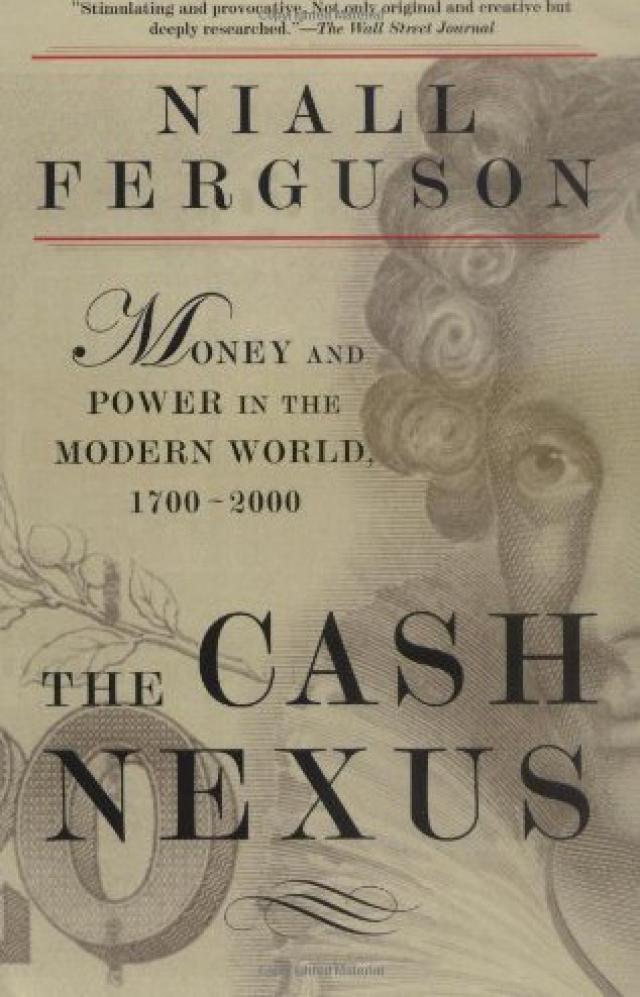
The Cash Nexus: Money and Politics in Modern History, 1700-2000

The Cash Nexus: Money and Politics in Modern History, 1700-2000

Niall Ferguson

Niall Ferguson

The Cash Nexus is the controversial history of money's central place in the world, from Niall Ferguson, bestselling author of Empire and Civilization Generations of historians have shied away from the truth behind the cliche: money makes the world go around. International bestseller Niall Ferguson answers the big questions about finance and its crucial place in bringing happiness and despair, warfare and welfare, boom and crash to nations buffeted by the onward march of history. Starting in 1700 and ending today, The Cash Nexus is a dazzling, powerful and controversial explanation of modern world history and the fundamental force that lurks behind it all. About the author: Niall Ferguson is one of Britain's most renowned historians. He is the author of Paper and Iron, The House of Rothschild, The Pity of War, Empire, Colossus, The War of the World, The Ascent of Money, High Financier, Civilization and The Great Degeneration. He has written and presented six highly successful television series for Channel Four: Empire, American Colossus, The War of the World, The Ascent of Money, Civilization and China: Triumph and Turmoil.
Read online
  • 66
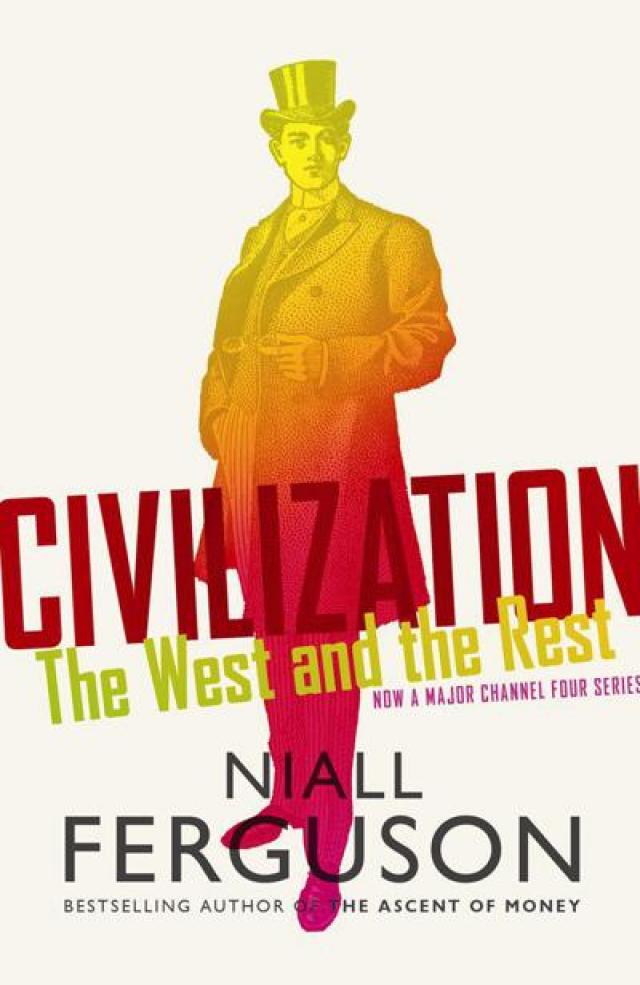
Civilization: The West and the Rest

Civilization: The West and the Rest

Niall Ferguson

Niall Ferguson

Ferguson is the most brilliant British historian of his generation ... he writes with splendid panache The Times One of the world's leading historians -- Hamish McRae Independent [Praise for The Ascent of Money] Beautifully written... Breathtakingly clever -- Martin Van Weyer Sunday Telegraph [Praise for The Ascent of Money] The tales he tells of boom and bust, of triumph and disaster, of bubbles that inflate... are the very essence of financial history -- Bill Emmott Financial Times [Praise for The Ascent of Money] An often enlightening and enjoyable tour through the underside of great events, a lesson in how the most successful great powers have always been underpinned by smart money
Read online
  • 53
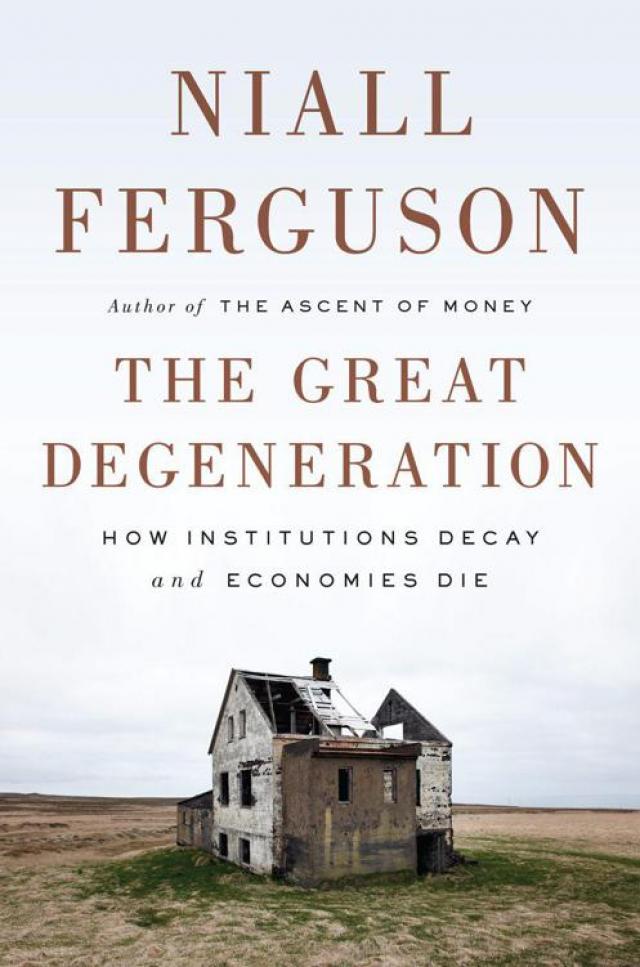
The Great Degeneration: How Institutions Decay and Economies Die

The Great Degeneration: How Institutions Decay and Economies Die

Niall Ferguson

Niall Ferguson

From renowned historian Niall Ferguson, a searching and provocative examination of the widespread institutional rot that threatens our collective futureWhat causes rich countries to lose their way? Symptoms of decline are all around us today: slowing growth, crushing debts, increasing inequality, aging populations, antisocial behavior. But what exactly has gone wrong? The answer, Niall Ferguson argues in The Great Degeneration, is that our institutions—the intricate frameworks within which a society can flourish or fail—are degenerating.Representative government, the free market, the rule of law, and civil society—these are the four pillars of West European and North American societies. It was these institutions, rather than any geographical or climatic advantages, that set the West on the path to global dominance beginning around 1500. In our time, however, these institutions have deteriorated in disturbing ways. Our democracies have broken the contract between the generations by heaping IOUs on our children and grandchildren. Our markets are hindered by overcomplex regulations that debilitate the political and economic processes they were created to support; the rule of law has become the rule of lawyers. And civil society has degenerated into uncivil society, where we lazily expect all of our problems to be solved by the state.It is institutional degeneration, in other words, that lies behind economic stagnation and the geopolitical decline that comes with it. With characteristic verve and historical insight, Ferguson analyzes not only the causes of this stagnation but also its profound consequences.The Great Degeneration is an incisive indictment of an era of negligence and complacency. While the Arab world struggles to adopt democracy and China struggles to move from economic liberalization to the rule of law, our society is squandering the institutional inheritance of centuries. To arrest the breakdown of our civilization, Ferguson warns, will take heroic leadership and radical reform.ReviewBrilliantly written, full of wit and virtuosity, stuffed with memorable lines and gorgeous bits of information. A great read The Times (on Civilization) A dazzling history of Western ideas ... epic Economist This is sharp. It feels urgent. Ferguson... twists his knife with great literary brio -- Andrew Marr (on Civilization) A masterpiece ... fascinating facts burst like fireworks on every page Sunday Times Brings history alive for the reader with a dazzling knowledge ... peerless Independent on Sunday About the AuthorNIALL FERGUSON is one of the world’s most renowned historians. He is the author of Paper and Iron, The House of Rothschild, The Pity of War, The Cash Nexus, Empire, Colossus, The War of the World, The Ascent of Money, High Financier, and Civilization. He is the Laurence A. Tisch Professor of History at Harvard University, a senior research fellow of Jesus College, Oxford, and a senior research fellow of the Hoover Institution, Stanford University. He is also a regular contributor to Newsweek and Bloomberg television.
Read online
  • 19
Colossus

Colossus

Niall Ferguson

Niall Ferguson

Is America an empire? Certainly not, according to our government. Despite the conquest of two sovereign states in as many years, despite the presence of more than 750 military installations in two thirds of the world’s countries and despite his stated intention "to extend the benefits of freedom...to every corner of the world," George W. Bush maintains that "America has never been an empire." "We don’t seek empires," insists Defense Secretary Rumsfeld. "We’re not imperialistic."Nonsense, says Niall Ferguson. In Colossus he argues that in both military and economic terms America is nothing less than the most powerful empire the world has ever seen. Just like the British Empire a century ago, the United States aspires to globalize free markets, the rule of law, and representative government. In theory it’s a good project, says Ferguson. Yet Americans shy away from the long-term commitments of manpower and money that are indispensable if rogue regimes and failed states really are to be changed for the better. Ours, he argues, is an empire with an attention deficit disorder, imposing ever more unrealistic timescales on its overseas interventions. Worse, it’s an empire in denial—a hyperpower that simply refuses to admit the scale of its global responsibilities. And the negative consequences will be felt at home as well as abroad. In an alarmingly persuasive final chapter Ferguson warns that this chronic myopia also applies to our domestic responsibilities. When overstretch comes, he warns, it will come from within—and it will reveal that more than just the feet of the American colossus is made of clay.Amazon.com Review"The United States today is an empire—but a peculiar kind of empire," writes Niall Ferguson. Despite overwhelming military, economic, and cultural dominance, America has had a difficult time imposing its will on other nations, mostly because the country is uncomfortable with imperialism and thus unable to use this power most effectively and decisively. The origin of this attitude and its persistence is a principal theme of this thought-provoking book, including how domestic politics affects foreign policy, whether it is politicians worried about the next election or citizens who "like Social Security more than national security." Ferguson, a British historian, has no objection to an American empire, as long as it is a liberal one actively underwriting the free exchange of goods, labor, and capital. Further, he writes that "empire is more necessary in the twenty-first century than ever before" as a means to "contain epidemics, depose tyrants, end local wars and eradicate terrorist organizations." The sooner America embraces this role and acts on it confidently, the better. Ferguson contrasts this persistent anti-imperialistic urge with the attitude held by the British Empire and suggests that America has much to learn from that model if it is to achieve its stated foreign policy objectives of spreading social freedom, democracy, development, and the free market to the world. He suggests that the U.S. must be willing to send money, civilians, and troops for a sustained period of time to troubled spots if there is to be real change—as in Japan and Germany after World War II--an idea that many American citizens and leaders now find repulsive. Rather than devoting limited resources and striving to get complex jobs done in a rush, Americans must be willing to integrate themselves into a foreign culture until a full Americanization has occurred, he writes. Overall, a trenchant examination of a uniquely American dilemma and its implications for the rest of the world. --Shawn CarkonenFrom Publishers WeeklyCriticism of the U.S. government's imperialist tendencies has become nearly ubiquitous since the invasion of Iraq began nearly a year ago, but Ferguson would like America to embrace its imperial character. Just as in his previous book, Empire, he argued that the British Empire had done much good, he now suggests that "many parts of the world would benefit from a period of American rule," as stability and a lack of corruption that could be brought by liberal imperial government would result in capital investment and growth. Similarly, he says, the British Empire acted as "an engine for the integration of international capital markets." The problems nations like India faced after the British left, he continues, could have been ameliorated if the colonization had been more comprehensive, more securely establishing the types of institutions that foster long-term prosperity. The primary shortcoming of America's approach to empire, Ferguson believes, is that it prefers in-and-out military flourishes to staying in for the long haul. His criticism of Americans as a people who "like social security more than they like national security" and refuse to confront impending economic disaster are withering, but he also has sharp comments for those who imagine a unified Europe rising up to confront America and for the way France tried to block the Iraqi invasion. The erudite and often statistical argument has occasional flashes of wit and may compel liberals to rethink their opposition to intervention, even as it castigates conservatives for their lackluster commitment to nation building. Copyright © Reed Business Information, a division of Reed Elsevier Inc. All rights reserved.
Read online
  • 18
183