The limits, p.1
The Limits, page 1


Also by Nell Freudenberger
Lucky Girls
The Dissident
The Newlyweds
Lost and Wanted
This Is a Borzoi Book
Published by Alfred A. Knopf
Copyright © 2024 by Nell Freudenberger
All rights reserved. Published in the United States by Alfred A. Knopf, a division of Penguin Random House LLC, New York, and distributed in Canada by Penguin Random House Canada Limited, Toronto.
www.aaknopf.com
Knopf, Borzoi Books, and the colophon are registered trademarks of Penguin Random House LLC.
Library of Congress Cataloging-in-Publication Data
Names: Freudenberger, Nell, author.
Title: The limits / Nell Freudenberger.
Description: First Edition. | New York : Alfred A. Knopf, 2024. | “A Borzoi Book.”
Identifiers: LCCN 2023005984 (print) | LCCN 2023005985 (ebook) | ISBN 9780593448885 (hardcover) | ISBN 9780593448892 (ebook)
Subjects: LCGFT: Novels.
Classification: LCC PS3606.R479 L56 2024 (print) | LCC PS3606.R479 (ebook) | DDC 813/.6—dc23/eng/20230221
LC record available at https://lccn.loc.gov/2023005984
LC ebook record available at https://lccn.loc.gov/2023005985
Ebook ISBN 9780593448892
This is a work of fiction. Names, characters, places, and incidents either are the product of the author’s imagination or are used fictitiously. Any resemblance to actual persons, living or dead, events, or locales is entirely coincidental.
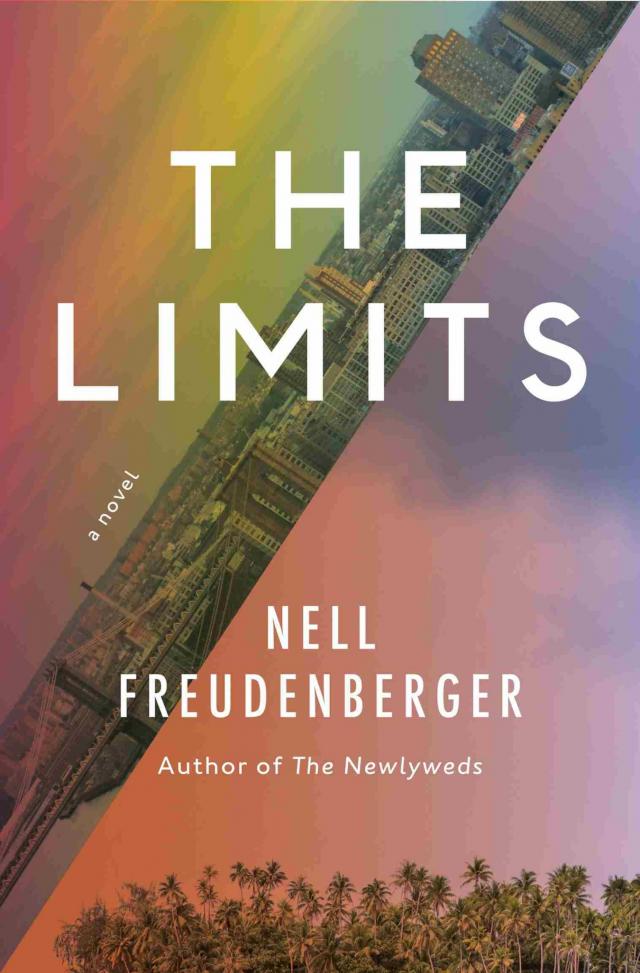
Cover photographs: (NYC) Christopher McLallen/Millennium Images, UK; (Tahiti) Antoine Boureau/Millennium Images, UK
Cover design by Kelly Blair
ep_prh_6.3_146677166_c0_r0
Contents
Cover
Also by Nell Freudenberger
Title Page
Copyright
Dedication
Epigraph
Chapter 1
Chapter 2
Chapter 3
Chapter 4
Chapter 5
Chapter 6
Chapter 7
Chapter 8
Chapter 9
Chapter 10
Chapter 11
Chapter 12
Chapter 13
Chapter 14
Chapter 15
Chapter 16
Chapter 17
Chapter 18
Chapter 19
Chapter 20
Chapter 21
Chapter 22
Chapter 23
Chapter 24
Chapter 25
Chapter 26
Chapter 27
Chapter 28
Chapter 29
Chapter 30
Chapter 31
Chapter 32
Chapter 33
Chapter 34
Chapter 35
Chapter 36
Chapter 37
Chapter 38
Chapter 39
Chapter 40
Chapter 41
Acknowledgments
A Note About the Author
_146677166_
For Cleo and Nic
Now I live here, another island,
that doesn’t seem like one, but who decides?
Elizabeth Bishop, “Crusoe in England”
1
She was already underwater when the sun came up. Twenty-five meters down, the first light hit the rose garden in patches, like a hand-colored photograph. Plated clusters of Montipora resolved from gray to green, brown fingers of Acropora blushed pink. The fish woke up, like birds. You could hear them snapping and grunting, crunching the coral between the steam puff and gurgle from the regulators. A trio of black-tipped reef sharks passed in the distance, propelling themselves with subtle, muscular flicks. They ignored the divers, who were so close to each other that Nathalie could feel the surge from Raffi’s fins. She put space between them, then indicated some coral outcroppings a little farther on, where the coastal shelf descended, then dropped off sharply to blue.
Nathalie would have preferred to dive alone. This was her favorite hour of the day, when her time was completely her own; something was lost, even with Raffi. But things were done correctly at CRIOBE, and she was scrupulous about protocol, as well as the research station’s equipment. No pleasure on earth was worth risking the place she’d made for herself here.
They backpedaled a moment to admire a school of yellow-tailed demoiselles wake up and start to feed. The damselfish avoided the white patches among the green, yellow, and purple of the reef, but the bleached coral wasn’t dead. It was only empty. Either the tiny algae that lived in its transparent tissue would return, restoring the coral’s healthy color, or that living tissue would shred away and die, leaving the calcareous skeleton.
Raffi touched her shoulder: a moray was emerging from underneath a rock. It was the same muddy green as the kelp and she had to admit that she wouldn’t have seen it without him; Raffi had that gift for spotting what other people missed. The jaws of the eel gaped and closed, gaped and closed, his tiny eyes perhaps as useless as her own without the mask. An iridescent bluestreak cleaner wrasse darted toward his head, safe in its knowledge that the moray wouldn’t eat its sleek servant.
Jardin des Roses was a beautiful name, but not entirely accurate. The Montipora looked more like mushrooms than like roses, and there was nothing cultivated about the landscape beneath them. It looked haphazard, but everything existed in precise balance with everything else; the plan had arisen according to the needs of each creature there. And not only the creatures. She really believed that the beauty was mathematical in nature, derived from the cycling of nitrogen and carbon through the living and nonliving components of the reef. The idea that it could be gone in a few years was sick.
When they came up there was only 20 bar left in her cylinder, and ʻŌpūnohu Bay was dark turquoise. Small waves whipped the surface, which had been still and silver on the way out. A sleek white cruiser was approaching the mouth of the bay, while a tug-style supply vessel she didn’t recognize, RV Persephone, sat at anchor inside the pass, under a Danish flag. Vertical cumulus clouds sat over the water like greater ships, throwing blankets of shadow on the steep, bottle-green hills. Mount Rotui rose up in front of them with its elongated ridge, as if it had been dragged toward the coast. There was some local legend about theft.
“Seven-forty,” Raffi said.
“Shit.” She was giving an informal tour to a research analyst from Pew, on vacation in the area. She thought briefly about having her exemplary German student, Gunther, start the tour, but these relationships with funders were crucial, and it really did have to be her.
They were chugging slowly toward the underpass, where the channel ran under the road to the station. Two children were standing on the shore, one eight or nine, the other barely more than a toddler. They were stooping and straightening and then stooping again, picking at something in the sand. Shells maybe, or unlikely treasures from the piles of sun- and salt-bleached plastic chips that washed up with the tides. Once she had picked a single diamond earring off a ledge, shed by some unlucky tourist; on shore another time a plastic baby, the size of a thumbnail, brittle and pink, its features washed away.
The older girl shaded her eyes to watch their boat coming in. There was nothing remarkable about a couple of divers returning on the skiff, and so she was surprised to see the younger one waving her arms over her head. Demoiselles, like the fish, traveling in a shoal—free, this early in the morning, from chores. Perhaps that was what made them so ebullient and friendly. She waved, and they redoubled their greeting.
“Professeure! Professeure!” Jumping up and down as if they’d won the lottery. Local girls whose parents ran fruit stands, fished, cleaned hotels. What did they want with her?
She thought she would start the tour outside, show the analyst the bay and say something about the dive this morning, before moving into the lab. If you were used to an air-conditioned office in D.C., you might enjoy the view of the mountains from the thatched Polynesian pavilion called fare pote’e. The American scientists at the station next door had a larger one, where they often took photographs, perhaps because they liked to think of themselves as more locally attuned than their French counterparts. Her friend Marie-Laure called the pavilions “un peu Disney.”
Raffi guided the boat under the road and into the green channel. They anchored at the CRIOBE dock. It was ten of eight, and they worked quickly, unloading the gear and hosing down the boat. She had a dry shirt and shorts in her dive bag, and she pulled them on over her damp suit, running her fingers through her wet hair. No time for coffee, but at least the delay would be short enough to excuse.
But the girls had followed them. They’d crossed the road in record time; the older one was now scampering alongside the channel, pulling the baby after her. She was wearing a red Hello Kitty tank top and a ruffled denim miniskirt with rickrack edging, a pink headband that secured a smooth topknot.
“Telephone for you! At the reception!”
Now she recognized them—the older, at least, was a relation of Veronique, who worked at the reception. Tahitian, emaciated, of an indeterminate but advanced age, and dressed always in bright local fabrics, Veronique nevertheless seemed, in her sour disdain for nearly all the lab’s employees, more French than anything else. It especially irked her when the friends or family members of the researchers who’d failed to reach their mobiles called the station, and Nathalie wasn’t surprised that she’d sent these emissaries rather than venturing out herself.
“An emergency,” the girl continued politely in French. “She’s waiting.”
Whether the “she” who was waiting was the caller or Veronique, Nathalie wasn’t sure. But there was no reason to panic, except with regard to the funders. She thanked the child, who smiled shyly from under her heavy thatch of bangs, and texted Gunther. Then she picked up her cylinder and BCD.
“Leave it,” said Raffi, “in case it’s Pia.” He spoke French with Nathalie but English with her daughter, who’d learned the languages simultaneously and had no preference. Nathalie had remarked on it when she first heard them, because French was certainly easier for Raffi. But Pia said pointedly that Raffi had referred to French as a “shit language” and would rather speak English. She said it with a sidelong look, as if she thought she might offend or shock her mother. Nathalie had long since learned not to react to that kind of thing. More likely, Raffi was just using Pia as practice for his tourists.
One afternoon stuck in her mind. She’d happened to be standing outside the reception and had seen them coming in from a dive on the boat. Pia had been wearing a black Speedo, a modest suit that nevertheless showed every detail of her body, the high breasts, the oval of tanned thigh and slice of buttock. They were struggling; she’d been standing carelessly, and he was telling her to sit down; while Nathalie watched, unobserved, Pia covered his eyes with her hands, laughing, forcing him to push her off.
Regarding Pia, she trusted Raffi completely. It was her daughter’s behavior she worried about, because that was the way she herself had always been. It wasn’t age so much as knowledge; she fell in love because a person knew something she didn’t.
“Go,” Raffi said, shouldering both of their vests and taking a cylinder in each hand. “I’ve got it.”
She walked on the dock, then jogged. People got excited about nothing here, any contact with the outside world. It was two in the afternoon in New York, and so Raffi was right: it was likely Pia, likely with something that only a fifteen-year-old would classify as an emergency. It was the last day of the year, but, like her, Stephen would certainly be at work.
The reception had an unpleasant, unreal feeling, the way places you knew well sometimes appeared in dreams. It was overlaid with an emotion, which she identified as fear only when she looked at Veronique, who indicated the landline on the desk with a gesture that was uncharacteristically respectful, almost sympathetic. It was early for her to be in; maybe she’d stopped in the office for something, was on her way somewhere else, had answered the call only by chance? Veronique seemed to confirm this by picking up her cigarettes and her purse before leaving Nathalie alone in the small office. For some reason Nathalie focused on the souvenir calendar pinned to the bulletin board above the desk, which featured, for December, the spectacular and ecologically devastating red lionfish.
“Pia?”
But it wasn’t Pia, nor was it her father. It was his wife, who was pregnant. When was her due date? The thought occurred to Nathalie that Kate was calling to tell her Pia had a sibling.
“Nathalie?”
“Yes?”
“I’m calling because I can’t reach Stephen.” She sounded panicked, hysterical, a quality Nathalie despised, especially in women. “And Pia’s supposed to be at Maxine’s. But she isn’t there.”
It didn’t seem to Nathalie like such an emergency. Weren’t there a million reasons a teenager might not be where she said she was? They’d had an argument, and so she’d left. She’d left to see another friend, or because she felt like it. Pia was independent, unlike American teenagers who traveled everywhere by car, whose parents kept track of them with GPS. She’d walked around the neighborhood on her own at nine; had taken the metro with her cousins as a young teenager in Paris.
“Have you tried calling her?”
“Of course. She went out to Maxine’s on Saturday, with another girl. She hasn’t been home since then.”
Whether or not the new apartment where Stephen lived with this younger wife was Pia’s home—well, that was debatable. “She is supposed to be staying at Maxine’s?”
“Out in East Hampton. Maxine’s mother just called.”
“Yes, okay.”
“I tried, but I couldn’t reach Stephen. He’s at the hospital.”
“But what am I supposed to do?”
There was a long pause. “I don’t know.” Her tone had changed. Now the woman sounded like what she was—a secondary school teacher, those dry and rigid women Nathalie remembered from collège. Correct and self-righteous, perfect for Stephen. “I thought she might have been in touch with you.”
“No.”
“Maxine’s mother said the girls haven’t seen her since Sunday morning.”
Now something clutched in her chest, an unpleasant pressure not unlike becoming unexpectedly low on air while diving. Today was Thursday. Thursday afternoon in New York. No one had seen Pia for four days?
“But you’ve only learned this now?”
Kate made a noncommittal sound, which Nathalie took as an admission of guilt. Who the hell was watching her child? Stephen was in the thick of the worst public health emergency in a century, but Kate was at home all day. It was hardly difficult.
“How is that possible?”
“They were with the housekeeper. Maxine’s mother is afraid the other girls were covering for her. She thought Pia could be with you.”
“Of course she’s not with me!”
“I know that,” Kate said. “I saw her on Saturday.”
Nathalie tried to be patient. Sometimes, when you wanted something from someone, no matter how urgently, you had to stop and imagine things from their perspective. It was something she practiced all the time with her colleagues at the station.
“I know this must be…hard for you.”
Kate didn’t say anything, and so Nathalie pressed on. “This situation. And your pregnancy.”
“Excuse me?”
She was on the point of mentioning what Stephen had told her. But had that been in confidence? In any case, this woman wanted no comfort from her.
There was a long silence, so that Nathalie thought there was a problem with the connection. “Katherine? Katherine! Can you hear me?”
“I can hear you.” A frosty, fuck-you voice.
Nathalie modified hers, dripping politeness. “Do you have any idea where Pia might be?”
“I have no idea,” Kate said. “I’m not her mother.”
2
The day Pia arrived had been so thick and hot that at two o’clock, Kate still hadn’t left the apartment. She looked at the brick face of the condominiums across the street and saw shimmering strings of light. The smart thermostat kept the apartment in the Laureate at exactly 72 degrees and so she’d postponed going out, until now it was too late. The message from Stephen said that Pia had just landed, but that he would be held up at the hospital for at least another couple of hours. He was sorry, and he loved her.
When they moved in together, she’d felt a mixture of excitement and guilt. She told herself that her marriage to Stephen didn’t mean that everything in her life had to change. It was true that their apartment was a significant distance in every sense from the one she’d shared until recently with Benji and May on one floor of a subdivided brick rowhouse in Gowanus. Although they’d taken turns borrowing from each other at the end of the month (Benji was the worst offender), Kate had never thought of herself as anything but solidly middle-class. By some of her students’ standards—63 percent of whom had household incomes low enough to qualify the school for Title I funding—she was rich.