The kimberley secret, p.1
The Kimberley Secret, page 1
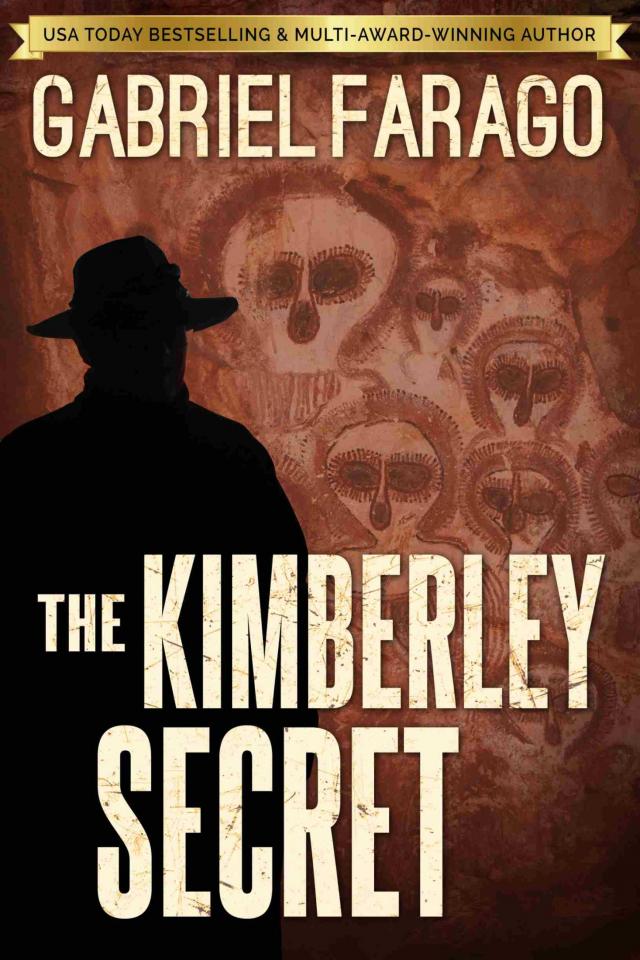


THE KIMBERLEY SECRET
A Historical Mystery Novella
“Before it all began …”
Gabriel Farago
This book is brought to you by Bear & King Publishing.
Publishing & Marketing Consultant: Lama Jabr
Website: https://xanapublishingandmarketing.com/
Sydney, Australia
First published 2018 © Gabriel Farago
The right of Gabriel Farago to be identified as the author of this work has been asserted by him in accordance with the Copyright Amendment (Moral Rights) Act 2000.
All rights reserved. Except as permitted under the Australian Copyright Act 1968 (for example, fair dealing for the purposes of study, research, criticism or review) no part of this publication may be reproduced, stored in a retrieval system, or transmitted in any form or by any means, electronic, mechanical, photocopying, recording or otherwise, without the written permission of the publisher.
This is a work of fiction. Names, characters, businesses, places, events and incidents are either the products of the author’s imagination or used in a fictitious manner. Any resemblance to actual persons, living or dead, or actual events is purely coincidental.
All rights reserved. Except as permitted under the Australian Copyright Act 1968 (for example, fair dealing for the purposes of study, research, criticism or review) no part of this publication may be reproduced, stored in a retrieval system, or transmitted in any form or by any means, electronic, mechanical, photocopying, recording or otherwise, without the written permission of the publisher.
This is a work of fiction. Names, characters, businesses, places, events and incidents are either the products of the author’s imagination or used in a fictitious manner. Any resemblance to actual persons, living or dead, or actual events is purely coincidental.
Table of Contents
Title Page
Claim Your Free Novella
Author’s Note
Battle of Takur Ghar: 4 March 2002
The Funeral: 11 March 2002
The Pawnbroker: 12 March 2002
The Painter in the Bush: 14 March 2002
The Poker Game
The Judge in Perth: 25 March 2002
Fremantle Prison: 26 March 2002
The Jazz Singer in New York: Morning, 30 March 2002
The Party in Manhattan: Afternoon, 30 March 2002
The Incident in Central Park: 31 March 2002
Hostage of the Taliban: 5 April 2002
The Portrait: Sydney: May 2002
Wandjina and Gwion: Wyndham: May 2002
The Pearl Baron: May 2002
The Ballerina in the Nursing Home: 2012
Madame Petrova’s Memory Trees: 2012
Kuragin Chateau, Just Outside Paris: Christmas Eve 2012
Three Months Later: Coberg Mission; March 2013
More Books by the Author
The Empress Holds the Key
The Disappearance of Anna Popov
The Hidden Genes of Professor K
Professor K: The Final Quest
The Curious Case of the Missing Head
The Lost Symphony
The Death Mask Murders
Jack Rogan Mysteries Box Set Books 1–4
About the Author
Connect with the Author
Claim Your Free Novella
Signup for the author’s New Releases mailing list and get a free copy of The Forgotten Painting* Novella and find out where it all began ... Click Here to Download
* I’m delighted to tell you that The Forgotten Painting has just received two major literary awards in the US. It was awarded the Gold Medal by Readers’ Favorite in the Short Stories and Novellas category and was named the ‘Outstanding Novella’ of 2018 by the IAN Book of the Year Awards.
Also by Gabriel Farago
Letters from the Attic
The Forgotten Painting
The Postmaster of Treblinka
The Empress Holds the Key
The Disappearance of Anna Popov
The Hidden Genes of Professor K
Professor K: The Final Quest
The Curious Case of the Missing Head
The Lost Symphony
The Death Mask Murders
Author’s Note
In December 2017, everything changed for me as an author. The Hidden Genes of Professor K – Book 3 in the Jack Rogan Mysteries Series – had just been voted ‘Outstanding Thriller of the Year’ by the Independent Author Network (IAN) in the US. This gave the book huge publicity and exposure worldwide, and created a lot of interest in Jack Rogan – the central character – and the series generally.
Then just before Christmas, I received a phone call from my publicist, Lama. ‘We’re getting a lot of enquiries about Jack,’ she said.
We had both received many emails from readers wanting to know more about Jack’s earlier life; what had shaped his character, and how he became the ‘incorrigible rascal’ my readers appear to love so much.
‘Good to hear,’ I said. ‘It shows we are engaging with them and creating interest in the series.’
‘True, but they all want to know more about Jack.’
I suspected at once where this was heading. ‘What’s on your mind?’ I asked with some trepidation.
‘Remember last time we rewarded your readers and subscribers with a free novella?’ Lama said.
‘Of course, The Forgotten Painting,’ I replied. ‘It was very well received.’
‘Exactly. We should do it again.’
‘What do you mean?’
‘Reward your readers for their loyalty and support, and at the same time pique their interest in the next book we are about to release by giving them what they are asking for.’
‘And what might that be?’
‘Another novella telling your readers more about Jack, his childhood, his family; in short, what makes him tick. And we should link it all to the books in the series generally.’
‘Is that all? Are you serious? You want me to write a novella? Now? I’m still finalising the next book, and about to go away for Christmas,’ I protested. ‘I promised my wife—’
‘Come on, you will enjoy it!’ Lama coaxed, casually brushing my concerns aside. ‘And one more thing,’ she added. ‘Make it a page-turner.’
And then she did something she has done many times before. She hung up on me.
I spent Christmas in New Zealand and thought a lot about all this during long walks through primeval rainforests and along the shores of pristine mountain lakes. All of my ideas for books seem to start that way.
I had done some research last year in the remote Kimberley wilderness in Western Australia with a novella about Jack Rogan’s earlier life in mind, but that was for later, not right now. However, in publishing, timing is everything, and deep down I knew Lama was right. Releasing a novella before the next book was published was definitely the right way to go, and Lama realised of course that I would come ’round. Eventually.
So, that’s how it all began. I must admit that once I started writing, everything fell into place and I enjoyed delving into Jack’s earlier life and secrets immensely! But please don’t tell Lama this!
However, before you start reading, just a few words about the novella as a literary genre:
The novella made its first appearance in the early Renaissance, especially in Italy and in France. Giovanny Boccaccio’s The Decameron (1335), and Heptameron (1559), penned by the French queen Marguerite de Navarre and modelled on The Decameron, were the trailblazers. However, it wasn’t until the late 18th and early 19th centuries that the novella took shape as the literary genre we know today.
Robert Silverberg in Sailing to Byzantium describes the novella as: “one of the richest and most rewarding of literary forms ... it allows for more extended development of theme and character than does the short story, without making the elaborate structural demands of the full-length book. Thus it provides an intense, detailed exploration of its subject, providing to some degree both the concentrated focus of the short story and the broad scope of the novel.”
Silverberg, Robert (2000). Sailing to Byzantium. New York; ibooks, inc. ISBN 0-7861-99059
The Kimberley Secret is a novella, and as such, it is of course much shorter than my novels, but without losing focus or scope. That was one of the reasons I have chosen this genre as the vehicle to explore certain aspects of Jack Rogan’s earlier life, and reveal a little more about his background and character.
Gabriel Farago
Leura, Blue Mountains, May 2018
Battle of Takur Ghar: 4 March 2002
Operation Anaconda was in full swing. Australian and coalition forces were locked in a fierce battle with the Taliban and al-Qaeda in the Paktia Province in Afghanistan. Pressing his precious camera to his flak jacket, Jack Rogan hit the ground as heavy machine-gun fire erupted from one of the caves on his right. This was soon followed by mortar fire from above. The battle raged for hours in the difficult terrain, riddled with heavily fortified caves and bunkers, but by nightfall, the Shai-Kot Valley had been secured. According to US estimates, between 500 and 800 rebel fighters had been killed.
Working as an experienced freelance war correspondent with an impressive track record – especially in sensitive hotspots in Africa – Jack had quickly earned the respect of the US forces operating in Afghanistan. Fearless, and maintaining his sense of humour even in the most dangerous situations, Jack’s easy-going – at times almost laconic – manner had endeared h
As soon as the guns fell silent, Jack took off his helmet, pulled his notebook out of his backpack and sat down on a rock ledge overlooking the valley. With the pungent smell of cordite and death still hanging in the air, he began to jot down his impressions of the battle he had just witnessed. Jack knew that to capture the authenticity of the moment was the most important part of his work; it gave his articles the edge. The next most important thing was timing. Still high on adrenaline, there was an almost feverish energy pulsating through Jack as he described the dramatic events of the past few hours. He knew that the newspaper which had commissioned the articles was standing by, waiting for his call. But before he could contact his editor in the US, his satellite phone rang inside his backpack.
The reception wasn’t good. Distorted by interference and constant crackling, the voice on the other end of the line sounded distant and could barely be heard.
‘Yes, yes. This is Jack Rogan,’ Jack almost shouted. ‘Who are you? Where are you calling from?’
‘The Felicitas Boarding House in Townsville. It’s about your father,’ said the voice.
‘What did you say?’
‘Your father.’
‘What about him?’
‘He wants to see you.’
‘I’m in Afghanistan, in the middle of a war,’ Jack said impatiently.
‘He’s dying.’
By calling in favours, Jack managed to hitch a ride on a helicopter taking the wounded back to Kabul. Leaving the barracks, he went straight to the room he rented near Bala Hissar, an ancient fortress to the south of the modern city centre, and quickly packed his duffel bag. Then he called a contact at the airport and made travel arrangements to take him home to Australia.
Waiting for his connecting flight in Singapore, Jack took a long shower at the airport and tried to get some sleep in the lounge. He had been travelling for many hours and felt drained and exhausted. However, the much-needed sleep wouldn’t come. Instead, memories of his childhood kept him awake as his mind drifted back to turbulent times spent on a remote cattle station in outback Queensland, where life was as harsh as the relentless sun and as unforgiving as the drought that punished the land all too often, causing unimaginable hardship and despair.
For a son to travel home after a long absence to see his dying father for the last time was a tough call, even for a battle-hardened war correspondent like Jack. Memories reach secret corners of the heart and stir up long-forgotten emotions that can easily overwhelm the unwary.
By the time Jack stepped off the plane in Townsville and caught a taxi to the modest boarding house on the outskirts of town, he thought he had steeled himself for the painful encounter he knew he was about to face. He had seen death in many guises, often too violent and brutal to photograph or describe. Death was never pretty. But when Jack entered his father’s darkened room and looked at the emaciated, motionless shell of a man staring into space, his heart sank and tears began to well up, impossible to suppress.
For a while Jack stood quietly by the door, trying to compose himself as he stared at that mountain of a man he used to admire, now reduced by deadly cancer to a crumbling hill about to turn to dust.
‘Dad?’ whispered Jack, choking with emotion.
His father turned his head towards his son as his eyes began to focus. ‘Jack?’
‘It’s me,’ said Jack. He walked over to the bed, sat down on the edge and reached for his father’s limp hand.
‘Good to see you, mate. Back from the war?’ said his father, his voice growing stronger.
Jack nodded.
‘I’ve got to tell you something important. There isn’t much time ...’
‘What?’
‘This will come as a bit of a shock, but you have to know,’ said his father, squeezing Jack’s hand. ‘I’ve had a lot of time to think about this, lying here. How to tell you ...’
‘What are you talking about?’
‘I’ve always loved you as my own ...’
Jack looked at his father and wondered where this was going.
‘But you’re not,’ continued his father, his voice growing faint.
‘I don’t understand.’
His father took a deep breath – his chest heaving – and looked at Jack. ‘You’re not my son; you’re not our son.’
Jack looked confused. He’s delirious, he thought, certain he had misunderstood.
‘You were brought to us as a baby. You were so tiny; only a few days old. Mum couldn’t have children. It was the tragedy of her life. It’s what drove her away. That and other things ...’
‘Jesus, Dad! What are you saying?’ demanded Jack as the words began to sink in.
‘We took you into our hearts and our home. We thought you were a precious gift – the answer to our prayers.’
He’s serious, thought Jack, his mind racing. Could this be true? ‘You’re not kidding, are you?’ he said.
‘No. I agonised over this for a long time. Whether to tell you ...’
‘So, why did you? What difference does it make today? You and Mum are my parents. Always have been. Always will be,’ said Jack, tears in his eyes.
‘It’s not that simple.
‘Isn’t it?’
‘I believe you are entitled to know who you are.’
‘I know who I am.’
‘Perhaps. But the truth is still the truth, whichever way we look at it.’
‘And you are just going to leave this here? Just like that? Or are you going to tell me more?’
‘There isn’t much more I can tell you. We never found out who your biological parents were.’
‘What, I just appeared at your doorstep out of nowhere? Is that it?’
‘Just about.’
‘Come on, Dad ... How?’
‘Someone brought you to our home ...’
‘Who?’ demanded Jack.
‘Gurrul.’
Gurrul was an Aboriginal stockman who had worked at the Rogan family cattle station all his life. He had been Jack’s friend and mentor ever since Jack could remember.
‘So, he would know?’
‘Where you came from? Who your parents ...?’ Obviously exhausted, Jack’s father closed his eyes and his voice became weaker. ‘Yes, I believe he would know,’ he whispered. ‘But he made a promise ...’
‘What promise?’
‘He promised not to tell, and we had to promise not to ask.’
‘Did you?’
‘Yes.’
Jack realised time was running out fast. ‘Is there anything else you can tell me? About where I came from, I mean.’
‘This may help,’ said his father and pointed to a piece of paper on the bedside table. ‘Give it to me.’
Jack picked up the paper and gave it to his father. ‘What’s this?’ he asked.
‘When you came to us, wrapped in a towel, you had something around your neck. Something beautiful and precious.’
‘What?’
‘When things got really tough during one of the terrible droughts, I took it to—’
‘What was it, Dad? Tell me!’ interrupted Jack. ‘You took it where?’
His father opened his eyes and looked at Jack for the last time. It was a look Jack would never forget; a look of bittersweet love and regret. Then his father’s eyes began to glaze over as his mind drifted back to his beloved homestead he had inherited from his father. ‘I have only one regret,’ he whispered. ‘I lost our land, the cattle, our home, your inheritance ... the link to our past ...’
For a terrible moment, Jack’s father’s breathing became violent. He was gasping for breath like a man drowning and stared at Jack with unseeing eyes as the grip of death tightened around his emaciated chest, squeezing life out of his disease-riddled body. Then suddenly, it was over and everything stopped.