

American gothic, p.1
American Gothic, page 1


Contents
List of Authors
Chronology
Thematic Table of Contents
Preface to the Second Edition
Editorial Principles
Acknowledgments
Introduction
Cotton Mather (1663–1728)
The Tryal of G. B. at a Court of OYER AND TERMINER, HELD IN SALEM, 1692
The Trial of Martha Carrier, at the COURT OF OYER AND TERMINER, HELD BY ADJOURNMENT AT SALEM, AUGUST 2, 1692
A Notable Exploit; wherein, Dux Faemina Facti [The Narrative of Hannah Dustan]
“Abraham Panther”
A surprising account of the Discovery of a Lady who was taken by the Indians in the year 1777, and after making her escape, she retired to a lonely Cave, where she lived nine years
J. Hector St. John de Crèvecoeur (1735–1813)
Letters from an American Farmer LETTER IX. DESCRIPTION OF CHARLES-TOWN; THOUGHTS ON SLAVERY; ON PHYSICAL EVIL; A MELANCHOLY SCENE
Charles Brockden Brown (1771–1810)
Somnambulism: A Fragment
Washington Irving (1783–1859)
The Legend of Sleepy Hollow. Found Among the Papers of the Late Diedrich Knickerbocker.
John Neal (1793–1876)
Idiosyncrasies
Nathaniel Hawthorne (1804–1864)
Alice Doane’s Appeal
Young Goodman Brown
Henry Wadsworth Longfellow (1807–1882)
The Skeleton in Armor
Edgar Allan Poe (1809–1849)
Hop-Frog
The Cask of Amontillado
The Facts in the Case of M. Valdemar
The Fall of the House of Usher
FIVE POEMS
Herman Melville (1819–1891)
The Bell-Tower
George Lippard (1822–1854)
from The Quaker City; or, The Monks of Monk Hall
Henry Clay Lewis (1825–1850)
A Struggle for Life
Rose Terry Cooke (1827–1892)
My Visitation
Emily Dickinson (1830–1886)
EIGHT POEMS
Louisa May Alcott (1832–1888)
A Whisper in the Dark
Harriet Prescott Spofford (1835–1921)
Her Story
Circumstance
Ambrose Bierce (1842–1914?)
An Inhabitant of Carcosa
The Death of Halpin Frayser
Henry James (1843–1916)
The Turn of the Screw
George Washington Cable (1844–1925)
Jean-Ah Poquelin
Madeline Yale Wynne (1847–1918)
The Little Room
Sarah Orne Jewett (1849–1909)
The Foreigner
Kate Chopin (1851–1904)
Désirée’s Baby
Mary E. Wilkins Freeman (1852–1930)
Old Woman Magoun
Luella Miller
Gertrude Atherton (1857–1948)
The Bell in the Fog
Anonymous (Folk Tale)
Talking Bones
Charles W. Chesnutt (1858–1932)
The Dumb Witness
The Sheriff’s Children
Charlotte Perkins Gilman (1860–1935)
The Giant Wisteria
The Yellow Wall-Paper
Elia Wilkinson Peattie (1862–1935)
The House That Was Not
Edith Wharton (1862–1937)
The Eyes
Robert W. Chambers (1865–1933)
In the Court of the Dragon
Edgar Lee Masters (1868–1950)
TWO POEMS
Edwin Arlington Robinson (1868–1935)
SIX POEMS
Frank Norris (1870–1902)
Lauth
Stephen Crane (1871–1900)
The Monster
Paul Laurence Dunbar (1872–1906)
The Lynching of Jube Benson
Alexander Posey (1873–1908)
Chinnubbie and the Owl
Jack London (1876–1916)
Samuel
H[oward] P[hillips] Lovecraft (1890–1937)
The Outsider
Select Bibliography
Index of Titles and First Lines
Index to the Introductions and Footnotes
“This is the definitive anthology of American Gothic tales, the one that offers the most representative range of major authors and texts, in addition to excellent introductions and helpful annotations. All of this has only been enhanced in this second edition, since now there is an even wider range of important Gothic works for students and more advanced scholars to study and interpret. For reading and understanding the American Gothic short story, then, there is no better single volume anywhere.” — Jerrold E. Hogle, University of Arizona
“This anthology is comprehensive and authoritative and will be an essential source for scholars and students for years to come. Professor Crow is to be congratulated for the meticulous care he has taken to introduce authors and for the extraordinary inclusiveness of the material selected.” — Andrew Smith, University of Sheffield
“This new edition of Charles L. Crow’s anthology presents a panoramic overview of the American Gothic tradition from its Puritan origins to the 1930s Weird tale. One of the main strengths of the collection lies in the fact that it places, alongside the intelligent selections from authors already rightly well associated with the genre (figures such as Hawthorne, Poe, Brown, Irving, and James), contributions from lesser known figures such as George Lippard, John Neal, Charles W. Chesnutt, and Cotton Mather, to name but a few. This edition also benefits from a much greater acknowledgment of the traditionally overlooked contributions to the genre made by female authors: Crow selects not just obvious authors and poets such as Emily Dickinson, Charlotte Perkins Gilman, Louisa May Alcott, and Edith Wharton, but also the likes of Rose Terry Cooke, Harriet Prescott Spofford, Gertrude Atherton, and Madeline Yale Wynne. It is a development which, as Crow acknowledges in his preface, reflects the considerable amount of scholarly work that has been done in this area since the first version of the book was published.
Academics and students will find helpful other new additions such as the chronology (which collates relevant literary events with historical ones) and the thematic table of contents, which helpfully groups extracts under suggestive headings such as ‘Animals,’ ‘Children,’ ‘Cities,’ and ‘Feminist Themes,’ thereby facilitating a rewarding cross-pollination of authors and texts that might not otherwise be considered alongside one another. The anthology’s thoughtful selection of texts and authors, and practical scholarly apparatus, mean that it should be an immensely useful resource for anyone teaching on courses related to this ever-expanding and influential subsection of American literary studies.” — Bernice Murphy, Trinity College Dublin
This second edition first published 2013
Editorial material and organization © 2013 John Wiley & Sons, Ltd.
Edition history: Blackwell Publishers Ltd (1e, 1999)
Wiley-Blackwell is an imprint of John Wiley & Sons, formed by the merger of Wiley’s global Scientific, Technical and Medical business with Blackwell Publishing.
Registered Office
John Wiley & Sons, Ltd, The Atrium, Southern Gate, Chichester, West Sussex, PO19 8SQ, UK
Editorial Offices
350 Main Street, Malden, MA 02148-5020, USA
9600 Garsington Road, Oxford, OX4 2DQ, UK
The Atrium, Southern Gate, Chichester, West Sussex, PO19 8SQ, UK
For details of our global editorial offices, for customer services, and for information about how to apply for permission to reuse the copyright material in this book please see our website at www.wiley.com/wiley-blackwell.
The right of Charles L. Crow to be identified as the author of the editorial material in this work has been asserted in accordance with the UK Copyright, Designs and Patents Act 1988.
All rights reserved. No part of this publication may be reproduced, stored in a retrieval system, or transmitted, in any form or by any means, electronic, mechanical, photocopying, recording or otherwise, except as permitted by the UK Copyright, Designs and Patents Act 1988, without the prior permission of the publisher.
Wiley also publishes its books in a variety of electronic formats. Some content that appears in print may not be available in electronic books.
Designations used by companies to distinguish their products are often claimed as trademarks. All brand names and product names used in this book are trade names, service marks, trademarks or registered trademarks of their respective owners. The publisher is not associated with any product or vendor mentioned in this book. This publication is designed to provide accurate and authoritative information in regard to the subject matter covered. It is sold on the understanding that the publisher is not engaged in rendering professional services. If professional advice or other expert assistance is required, the services of a competent professional should be sought.
Library of Congress Cataloging-in-Publication Data
American gothic : From Salem witchcraft to H. P. Lovecraft, An Anthology / edited by
Charles L. Crow. – Second edition.
pages cm
Previous edition: American gothic : an anthology, 1787–1916. Malden, Mass. : Blackwell, 1999.
Includes bibliographical references and indexes.
ISBN 978-0-470-65980-9 (cloth) – ISBN 978-0-470-65979-3 (pbk.) 1. American literature.
2. Gothic revival (Literature)–United States. 3. Supernatural–Literary collections.
4. Horror tales, American. 5. Fantasy literature, American. 6. Fear–Literary collections.
I. Crow, Charles L.
PS507.A56 2013
810.8–dc23
2012016772
A catalogue record for this book is available from the British Library.
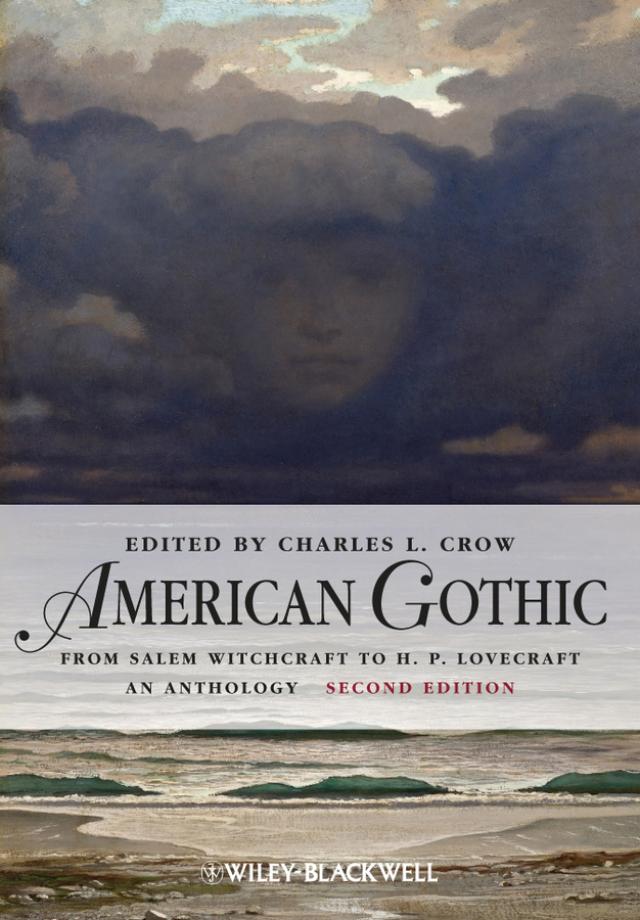
Cover image: Elihu Vedder, Memory, 1870. Los Angeles County Museum of Art, Mr and
Mrs William Preston Harrison Collection 33.11.1. © 2012 Digital image Museum Associates /
LACMA / Art Resource NY / Scala, Florence.
Cover design: Richard Boxall Design Associates
Ornament image © Keith Bishop / iStockphoto
List of Authors
Louisa May Alcott (1832–1888)
Gertrude Atherton (1857–1948)
Ambrose Bierce (1842–1914?)
Charles Brockden Brown (1771–1810)
George Washington Cable (1844–1925)
Robert W. Chambers (1865–1933)
Charles W. Chesnutt (1858–1932)
Kate Chopin (1851–1904)
Rose Terry Cooke (1827–1892)
Stephen Crane (1871–1900)
J. Hector St. John de Crèvecoeur (1735–1813)
Emily Dickinson (1830–1886)
Paul Laurence Dunbar (1872–1906)
Mary E. Wilkins Freeman (1852–1930)
Charlotte Perkins Gilman (1860–1935)
Nathaniel Hawthorne (1804–1864)
Washington Irving (1783–1859)
Henry James (1843–1916)
Sarah Orne Jewett (1849–1909)
Henry Clay Lewis (1825–1850)
George Lippard (1822–1854)
Jack London (1876–1916)
Henry Wadsworth Longfellow (1807–1882)
H[oward] P[hillips] Lovecraft (1890–1937)
Edgar Lee Masters (1868–1950)
Cotton Mather (1663–1728)
Herman Melville (1819–1891)
John Neal (1793–1876)
Frank Norris (1870–1902)
“Abraham Panther” (?)
Elia Wilkinson Peattie (1862–1935)
Edgar Allan Poe (1809–1849)
Alexander Posey (1873–1908)
Edwin Arlington Robinson (1869–1935)
Harriet Prescott Spofford (1835–1921)
Edith Wharton (1862–1937)
Madeline Yale Wynne (1847–1918)
Chronology
Date
Literary Event
Historical Event
1663
Cotton Mather b.
1689
Mather, Memorable Provinces, Relating to Witchcrafts and Possessions
1692
Salem Witch trials begin
1693
Mather, The Wonders of the Invisible World
Witch trials end
1702
Mather, Magnalia Christi Americana
1728
Cotton Mather d.
1735
J. Hector St. John de Crèvecoeur b.
1771
Charles Brockden Brown b.
1776
United States Declaration of Independence
1787
Anon., “An Account of a Beautiful Young Lady”
1794
William Godwin, Caleb Williams
1798
Brown, Wieland
1799
Brown, Arthur Mervyn, Ormond, Edgar Huntly
1782
Crèvecoeur, Letters from an American Farmer
1783
Washington Irving b.
1787
U.S. Constitution signed
1793
John Neal b.
1803
Louisiana Purchase
1804
Nathaniel Hawthorne b.
1807
Henry Wadsworth Longfellow b.
1809
Edgar Allan Poe b.
1810
Charles Brockden Brown d.
1812
War with Britain
1813
J. Hector St. John de Crèvecoeur d.
1818
Mary Shelley, Frankenstein
1819
Irving, The Sketch Book begins serial publication
Herman Melville b.
1820
Missouri Compromise
1822
George Lippard b.
1825
Henry Clay Lewis b.
1827
Rose Terry Cooke b.
1830
Indian Removal Act signed
Emily Dickinson b.
1831
Poe, Poems by Edgar A. Poe
1832
Louisa May Alcott b.
1835
Harriet Prescott Spofford b.
1836
Ralph Waldo Emerson, Nature
1837
Hawthorne, Twice-Told Tales
1838
Poe, The Narrative of Arthur Gordon Pym
1840
Poe, Tales of the Grotesque and Arabesque
1841
Longfellow, Ballads and Other Poems
1842
Ambrose Bierce b.
1843
Henry James b.
1844
Lippard, The Quaker City; or, the Monks of Monk Hall
George Washington Cable b.
1845
Poe, Tales
Poe, The Raven and Other Poems
1846
Hawthorne, Mosses from an Old Manse
1847
Madeline Yale Wynne b.
1848
Gold discovered in California
1849
Edgar Allan Poe d.
Sarah Orne Jewett b.
1850
Hawthorne, The Scarlet Letter
Harper’s New Monthly Magazine founded
Henry Clay Lewis d.
Lewis, Odd Leaves from the Life of a Louisiana Swamp Doctor
1851
Melville, Moby-Dick
Hawthorne, House of the Seven Gables
Kate Chopin b.
1852
Hawthorne, The Blithedale Romance
Melville, Pierre
Mary E. Wilkins Freeman b.
1854
George Lippard d.
1856
Melville, Piazza Tales
1857
Melville, The Confidence Man
Dred Scott decision by Supreme Court
Atlantic Monthly founded
Gertrude Atherton b.
1858
Cooke, “My Visitation”
Charles W. Chesnutt b.
1859
Charles Darwin, The Origin of Species
John Brown’s raid on Harper’s Ferry
Washington Irving d.
1860
Hawthorne, The Marble Faun
Abraham Lincoln elected
Spofford, “Circumstance”
Charlotte Perkins Gilman b.
1861
Civil War begins
1862
Elia Wilkinson Peattie b.






