

To die beautiful, p.1
To Die Beautiful, page 1
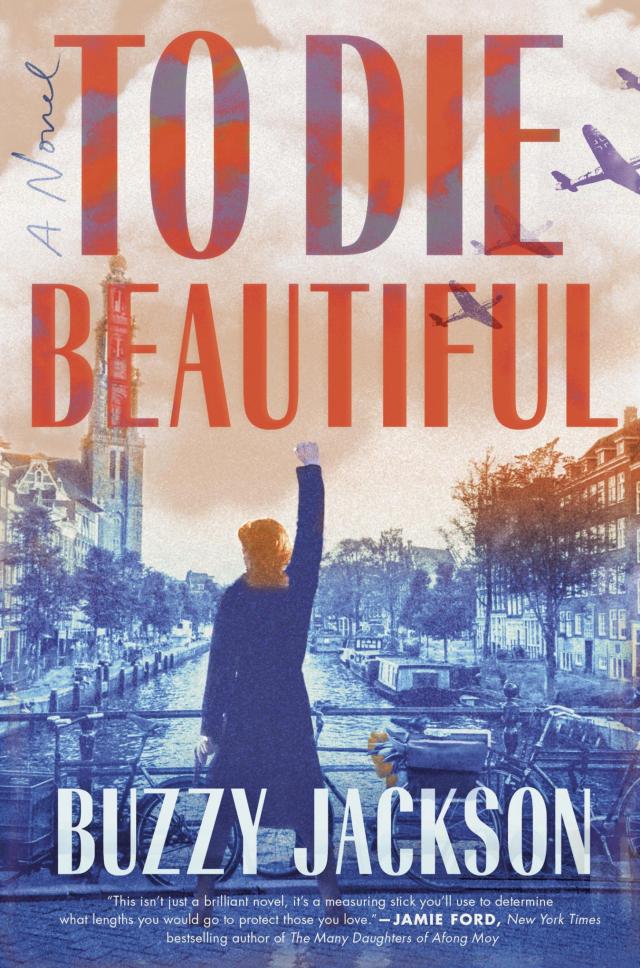


Also by Buzzy Jackson
The Inspirational Atheist: Wise Words on the Wonder and Meaning of Life
Shaking the Family Tree: Blue Bloods, Black Sheep, and Other Obsessions of an Accidental Genealogist
A Bad Woman Feeling Good: Blues and the Women Who Sing Them
An imprint of Penguin Random House LLC
penguinrandomhouse.com
Copyright © 2023 by Buzzy Worldwide LLC
Penguin Random House supports copyright. Copyright fuels creativity, encourages diverse voices, promotes free speech, and creates a vibrant culture. Thank you for buying an authorized edition of this book and for complying with copyright laws by not reproducing, scanning, or distributing any part of it in any form without permission. You are supporting writers and allowing Penguin Random House to continue to publish books for every reader.
DUTTON and the D colophon are registered trademarks of Penguin Random House LLC.
library of congress cataloging-in-publication data
Names: Jackson, Buzzy, author.
Title: To die beautiful: a novel / Buzzy Jackson.
Description: New York: Dutton, [2023]
Identifiers: LCCN 2022020456 | ISBN 9780593187210 (hardcover) | ISBN 9780593187227 (ebook)
Subjects: LCSH: Schaft, Hannie, 1920–1945—Fiction. | World War, 1939–1945—Collaborationists—Netherlands—Fiction. | World War, 1939–1945—Underground movements—Netherlands—Fiction. | Netherlands—History—German occupation, 1940–1945. | LCGFT: Historical fiction. | Novels.
Classification: LCC PS3610.A3454 T6 2023 | DDC 813/.6—dc23/eng/20220711
LC record available at https://lccn.loc.gov/2022020456
Cover design by Kaitlin Kall and Jason Booher
Figure by Mark Owens/Arcangel; canal by ElOjoTorpe/Getty Images
book design by Katy Riegel, adapted for ebook by Molly Jeszke
This is a work of historical fiction inspired by the extraordinary young women who bravely served as Nazi Resistance fighters in Holland during World War II. The narrative’s references to real-life historical figures, events, and places are not intended to change the entirely fictional nature of the work. Names, characters, dialogue, events, and places either are products of the author’s imagination or are used fictitiously. In all other respects, any resemblance to persons, living or dead, is entirely coincidental.
pid_prh_6.0_143319814_c0_r0
Dedicated to:
Rhoda and Leon F. Litwack, lives devoted to love and justice
I spent five years sitting next to her in class. She was very quiet, never joined in, and did not attend school parties. She never laughed and rarely smiled. But then, one time, somebody teased her. She reacted very fiercely. And that’s when I realized: if you mess with this kitten, you better wear gloves.
—Cornelius Mol, on his high school classmate Hannie Schaft
I have a lot of respect for pacifists. I don’t mean people who just profess to love peace. I mean those who stand up for their beliefs, because the world is currently drunk on war.
—Hannie Schaft, excerpted from her high school essay “People I Admire”
We would be starting a kind of secret army . . . and we were the only girls.
—Freddie Oversteegen, on joining the Dutch Resistance at age fourteen with her sister, Truus
Contents
Historical Note
Prologue
1945, Amstelveenseweg Prison, Amsterdam
Part One: OZO
1940–1943, Amsterdam
Part Two: The RVV
1943–1944, Haarlem
Part Three: The Hunger Winter
1944–1945, Haarlem
Part Four: The Dunes
March–April 1945, Harlem, Amsterdam, Bloemendaal
Afterword
Author’s Note
Acknowledgments
Notes
_143319814_
Historical Note
Nazi Germany invaded the neutral Netherlands on 10 May 1940, destroying much of the historic city of Rotterdam in a blitzkrieg attack, and took power five days later. The fanatically antisemitic Austrian Arthur Seyss-Inquart, who had colluded with Adolf Hitler in the Anschluss and Kristallnacht in 1938, was then appointed Reichskommissar (Reich commissioner) of the Netherlands, setting in motion the terror to come.
Anne Frank is the most famous victim of the Dutch Holocaust. Her story—resisting, hiding, betrayal, murder—was not unusual. More Jews were killed in the Netherlands than in any other Nazi-occupied European country: an estimated 75 percent (approximately 102,000 individuals) did not survive the war. To explain these numbers, survivors and historians have argued that the flat, densely populated geography of the Netherlands made it a difficult place in which to hide; there were no vast forests or mountain ranges into which one might disappear. Another factor in the Dutch experience might have been the relatively slow implementation of anti-Jewish measures by the Nazis in the Netherlands, which delayed the development of the Resistance movement.
Yet the Netherlands was also the site of the remarkable February strike of 1941, the first and only mass protest by non-Jews against antisemitic Nazi policies in Europe. Organized by the Dutch Communist Party, approximately three hundred thousand Dutch citizens mounted a huge nationwide general strike and demonstrations for three days, until it was violently put down by the Nazi occupiers and dozens of the movement’s organizers were killed.
As the war went on, Dutch citizens engaged in forms of passive resistance such as displaying the national color, orange; reading contraband Resistance newspapers; and listening to Radio Oranje, the London-based radio programs of the exiled Dutch government. Among the general population of the Netherlands, approximately 5 percent are estimated to have openly collaborated with the Nazis. It is estimated that another 5 percent of the Dutch population participated in active resistance by sheltering Jews, spying on the Germans for the Allies, or taking up arms in direct confrontation with the Nazi occupiers. Of these armed resisters, only a few were women.
Prologue
1945
Amstelveenseweg Prison, Amsterdam
You can walk right past your fate your whole life without seeing it, but prisons are inconspicuous by design. The Amstelveenseweg prison occupies an entire city block, hewn out of slabs of pitted gray stone like something built for a pharaoh. I must have seen the building a thousand times on my way to the university. Yet none of this is familiar.
As I’m escorted into the central atrium, the air cools, the acoustics sharpen. Low whispers echo off soaring steel beams. If there are male captives here, I don’t see them. Instead, women of all ages, from lanky teenagers to the hunched and elderly, are grouped by twos and threes in their cells, talking or praying, trying to sleep.
Heads snap up when I pass by, and I feel their eyes on me from behind. That’s when the murmurs begin. The guards on either side of me tighten their grip, greedy fingers fanged around my upper arms.
“Mach,” the guard says. Keep going.
We do, but the whispering slips past us like an incoming fog, rushing ahead into the hundreds of tiny, cold cells stacked four stories high. With each step I take, the sound grows stronger, thicker, louder.
The shuffle of women moving to the bars of their cells to watch. The clang of a shaken cell door, metal banging on metal. Something is growing. Somewhere high above me I hear clapping . . .
“Ruhe!” a guard above us says. Silence.
There is silence, for a moment. Then, across the atrium on another floor, two inspired souls let out a low whoop. The fog unfurls itself everywhere, swirling around us in the quietest of uproars, a floating, growing mist of righteousness. The sound of hope. Even here, in this place.
By the time I reach the end of the walkway, the women are greeting me by name.
Hannie, Hannie. Het meisje met het rode haar. Hannie Schaft.
The Girl with Red Hair. Hannie.
I don’t acknowledge them.
When I pass the last cell, I pause to look inside. An older woman with deep-socketed eyes and long, uncombed hair rests on a cot, one knobby shoulder against the cell’s cold wall for support. Her skin is ashen, and with her eyes closed she looks dead. They slowly open.
She sees me. I see her. Somehow, this corpse lifts her claw of a trembling hand. I’ve never met her, but I know her.
Too weak to stand, she raises one bony fist in salute.
“Verzet!” she whispers.
Resist.
I intend to.
Part One
OZO
1940–1943
Amsterdam
Chapter 1
Autumn 1940
I wasn’t always an only child.
Sitting on the chipped sink before me, the silver bird waits, frozen in flight, a silhouette like a bomber plane with two wings outstretched, tail swirling into a flirtatious spiral. A sparrow. I’d tried it on the last time I went to a music concert. Months ago.
It was Annie’s pin, of course. Father gave it her after the real sparrow flew away. I was young, about four at the time, so Annie was nine. It had been after midnight, and I was asleep when Annie poked me in the arm.
* * *
—
“Johanna, look.” Holding a candle in one hand, she pointed with the other to the floor besi de the bed we shared. There stood a small brown-and-gray bird, his head cocked to look at us as if listening to Annie’s words. He peeped. I gasped and Annie threw her hand across me. “Shh!”
“Let him fly out the window,” I said.
“I tried,” she said. “But he flew right back in.”
I didn’t believe her. Peering over my sister’s shoulder, I watched the ball of fluff bob and strut, his tiny claws a whisper on the floorboards. He finally fluttered up to the open window and flung himself outside. “See?” I said. “He’s gone.”
But half a second later the bird was back at the window, flapping against the glass in a zigzag panic before slipping inside, landing, then hopping to his chosen spot on the floor beside our bed. He peeped at us again.
“What do we do with him?” I asked.
“We keep him,” Annie said. Annie always knew the answer.
We did keep him, for a while. When he finally flew away for good, Father gave Annie the silver bird pin, a hand-me-down from our oma. I was jealous, but it made sense: Annie was sparrowlike in her energy, her spark, her curiosity. They said Oma had been like that, too. A few months later, Father gave me my own pin: a small silver fox. It was brand-new.
“Mijn kleine vos,” he said, “for you.” My little fox.
“But I didn’t find a fox,” I said, confused. “Annie found a bird.”
He laughed. “Your red hair, silly.” He picked me up and buried his face in my curls.
It was the first time I understood that there was a difference between who I knew I was, on the inside, and who other people thought I must be.
* * *
—
Just pin the damn thing on. I snatched the sparrow from the edge of the sink and poked its pin through the double-ply wool of my coat’s lapel, instantly piercing my thumb on the other side. “Damn it.”
“This is why they warn innocent young girls about the evil big city,” said Nellie. “She’s swearing like a pirate already.” She and Eva tumbled through the door of the attic apartment we shared, laughing.
“Damn it, damn it.” I’d tried to remove the brooch with my bleeding thumb and now the camel-colored wool was stained. I thrust it under the tap.
“Here, let me,” said Eva, the mother of our group. The three of us had gone through school together in Haarlem, though we hadn’t been close. They’d picked me because they knew me: the shy girl who did as much extra credit work as the teacher would give her; the girl who wore two sweaters on a spring day because her mother was sure she’d die of the common cold. I wasn’t the type to cause trouble.
“My, where did this come from?” Nellie held up the pin, glinting in the low light. “It’s pretty.”
“My sister,” I said, grabbing it back. “Thanks, I’ve got to get going, I’m late.”
“Sorry,” said Nellie.
“It’s fine, I’m just late,” I said, already out on the landing and headed down the narrow stairs. My cheeks flamed and my lashes were wet. Annie had been dead thirteen years now. Stupid sparrow.
* * *
—
I was an expert at being nobody. I’d practiced it for years. So that evening I took my place in the university’s grand ballroom in the spot I always felt safest: the back of the room. I made sure to take a glass of seltzer when it was offered to me, to have something to do with my hands. I sipped it while the room filled with university students, their conversations humming around me. The girls on the entertainment committee of the AVSV, the Amsterdam Female Student Association, flocked by the entrance with their bright dresses and musical voices. They welcomed everyone inside, especially the boys, whose arms and shoulders they touched as they talked. Sometimes they even hugged the boys and kissed them on the cheek. What did it feel like to be so relaxed with boys? Was I supposed to call them men? They seemed so boyish.
“ ’Scuse me,” said one now, a male student backing into me as he searched for his companions.
“Excuse you,” I agreed. Like baby giants, these young men, trampling on the world around them.
“Can I have a light?”
I flinched, annoyed. But it was a young woman about my age.
“Didn’t mean to scare you,” she said.
She was taller than me by several inches, which made her about five foot seven, but her presence was so grand she seemed even taller. Glossy brown-black hair fell to her bare shoulders in waves, the midnight darkness of her hair contrasting with the pale blue sky of her crinoline party dress. Her eyes were amber, with long, curled lashes and a surprisingly innocent gaze. Her lips were painted a tropical coral pink. She looked like a movie star. With my beige skirt and plain white blouse, I was surprised she’d even noticed me. She kept smiling. She blinked.
“Sorry,” I said. “I don’t have one.” I really was sorry because I didn’t want her to walk away yet. I’d tried smoking; it made me cough. But now I made a mental note to try again. It might make moments like this easier.
“What, a light?” she said. “Or a cigarette?”
“Either,” I said, then corrected myself: “Neither.”
She laughed, a chiming giggle that was friendly, not mean. “Philine! Over here.” She waved at another dark-haired girl weaving her way through the crowd. This new girl, Philine, was a bit taller than me and slightly less of a spectacle than her friend. She was pretty, but in a more approachable way. Brown hair, brown eyes, a relaxed smile. Her dress looked as if it had been taken in and let out a few times at the hem, following the fashion. Mine had, too. Like her friend, Philine carried herself with a natural confidence. I could picture both of them on a movie screen. I, on the other hand, might be eligible to audition for the heroine’s plain but intelligent friend. The sensible one.
“Why are you hiding back here, Sonja?” Philine asked her friend. “Trying to escape your suitors?”
“Something like that,” Sonja said. “I thought members of the AVSV were supposed to look out for each other, but this one won’t give me a light.” She winked at me. My face flamed with embarrassment. I was twenty; I should have learned how to smoke by now.
Philine smiled at me. “I’m Philine. What’s your name?”
“Hannie,” I said, shocking myself. Everyone had always called me Johanna or Jo, but I had been contemplating giving myself a new identity when I started at the University of Amsterdam a year earlier. I hadn’t actually tried it until now. The name seemed pretentious. Too bold. And I wasn’t sure I’d really earned the right to think of myself as a different person.
“Hannie,” she said, accepting my name without a blink. Like anyone would. Mother always said I thought too much.
Philine shook my hand. “And you’ve already met Princess Sonja.” My eyes widened. “She’s not a real princess,” Philine said, smiling and still clasping my hand.
“Well, I am related to the Habsburgs on my mother’s side,” said Sonja with a hint of pride.
“I’ll believe it when you marry a prince,” said Philine. “What about you? Are you a princess? Or just a normal boring law student like us?”
I beamed back at them. They were so smart and pretty and bursting with energy, and I was desperate to keep talking to them. I’d hoped to make more friends at university than I had in high school, but I was making the same mistakes all over again, turning down invitations for coffee by claiming I had too much homework to do. I didn’t have more than anybody else, but the thought of socializing with strangers made my palms sweat. They were damp now. I was only at this party because I’d made a vow earlier in the week to go and stay for at least thirty minutes. There were eight more to go.
“Just a boring law student,” I said, feeling a bit more relaxed in the sunny presence of these two. How novel. “I’m from Haarlem.”
“Lovely,” said Philine.
“Never been,” said Sonja.
“Sonja!” said Philine.
“What?”
“You’ve been to Paris and Rome, but you’ve never been to Haarlem? It’s ten miles away.”






