Blind site, p.1
Blind Site, page 1
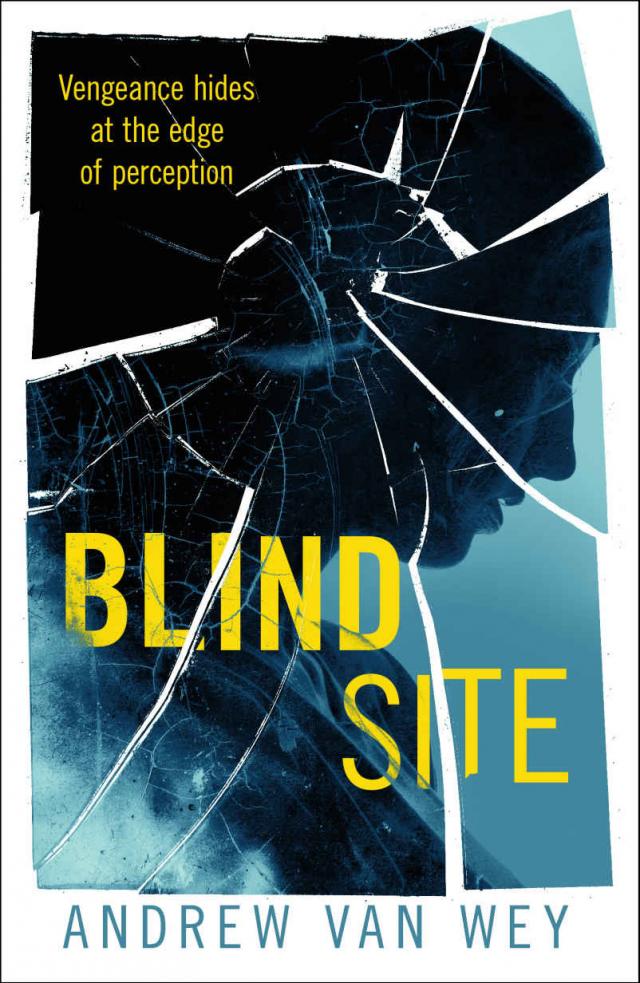


Blind Site
Andrew Van Wey
GREYWOOD BAY
Copyright © 2021 by Andrew Van Wey
This book is a work of fiction. The characters, incidents, and dialogue are products of the author's warped imagination and should obviously not be construed as real. Any resemblance to actual events or persons, living or dead, is entirely coincidental. Furthermore, any resemblance to actual events should be documented for science.
BLIND SITE. Copyright © 2021 by Andrew Van Wey. All rights reserved. Printed in the United States of America. No part of this book may be used or reproduced in any manner whatsoever without written permission except in the case of of brief quotations embodied in critical articles and reviews.
Cover Design: Stuart Bache | Books Covered UK
ISBN-13: 978-1-956050-01-1 (hardcover)
ISBN-13: 978-1-956050-00-4 (paperback)
V.21.9.4
Visit the author online: andrewvanwey.com
Trigger Warning
The millions of listeners and viewers who tune in to my daily show know that I am a trusted voice in these strange and frightening times.
My publisher, however, has insisted that I include this warning for those of a more delicate nature.
So, if bad words bother you, if violence and suspense knot your stomach, if discomforting facts unsettle your mind, then consider yourself warned. Put this book back on the shelf. Point yourself in a more soothing direction. Perhaps the bookstore staff can lead you to that colorful section with its stickers and children’s books and promises of happy endings. You won’t find that here.
But you will find the truth.
—Sam Stephens
The Conspiracy Isn’t a Theory: Your Prepbook for the Next Revolution
Prologue
Then
It began in a deep place of forged metal and stone, with an alarm’s blinking red light and a man who thought, This better be good.
Security guard Roger Fenton regarded the console as experience had taught him. Another government drill, no doubt, and paperwork to follow. His vision shifted, past the winking red light, past the framed photo of his wife, to the TV’s blue hue and the news from the edge of the Iron Curtain. East Germans on-screen, taking hammers to the wall, shattering concrete and bending rebar; West Germans gathering at the Brandenburg Gate, welcoming the fall. President Bush’s face filled all nine inches of the portable TV.
Then static consumed it.
Roger smacked the old Sony. This was breaking news, dammit. The alarm could wait.
Then the TV screen exploded.
Roger’s annoyance vanished. So did his hearing, along with half his left ear. Lips that had sneered at the alarm seconds ago were now speckled with glass. His front teeth were crimson shards, holes he wouldn’t notice for minutes. Now, he tasted the tang of adrenaline. Now, the alarm had his full attention.
Roger pulled himself off the floor. With a flick, he depressed the red lockdown switch. Then he was on his feet, limping down the hall. Klaxons wailed along the concrete walls. Machinery rumbled deep in the facility, emergency systems now coming online.
As he inserted his keycard in the reader at the RESTRICTED end of the hall, he felt—no, he knew—something was behind him. A frigid glare bloomed upon the nape of his neck.
Impossible. He was the only guard on duty. For an eight-hour shift, this corridor was his. Three hundred feet of metal and concrete, two magnetically locked doors, one at each end. His employers had given him these tools: a thermos and a gun, a new IBM computer and an old Sony TV. And they had given him orders: in case of emergency, guard the far door.
Trembling, he tongued the shards of his front teeth. Needles pierced his jaw as he plucked glass from his face. He was wounded, yes. He needed medical attention. To hell with this job.
Then he heard the voice.
“Help…”
He spun. The hallway—his hallway—bathed in flickering red light. Color-coded piping threaded the walls: blue for compressed air, green for steam, orange for chemicals. His TV, splayed open and sparking.
But it wasn’t the dying Sony that loosened Roger’s bladder. Nor the acrid fumes of burnt circuits, the whining of his burst eardrum, the alarms crying, Eee-ooo, eee-ooo.
It was the woman floating in the hallway.
Or rather, it was half of her.
A glistening form, nude and wreathed in smoke, hung in the air with arms outstretched. Wet hair clung to her breasts, curtains over a heaving chest. Her stomach was translucent. Where hips should have met thighs, flickering ribbons swayed, like kelp in gray water.
Warmth dribbled down Roger’s leg, his courage pooling in his size eleven boot.
“Help me, please!” cried the fractured woman. She was twenty feet away, yet her words enveloped him, wet echoes bristling every hair on his skin. “Make them stop!”
In a blossom of red glass, the lockdown lights burst. Shadows swallowed the halls. The wailing klaxons sighed as the electrical systems fell offline. Darkness, and silence. Only the ambient groan of the mountains above these subterranean halls.
Roger’s left hand crossed his hip, grasped his flashlight. His right hand fumbled for his service revolver. With two snaps of a leather clasp, he had his .38 Special in one hand, his Maglite in the other, wrists crossed in the Harries technique. Funny how fast his training came back.
What wasn’t funny was the hallway before him.
One hundred yards of dark concrete. The sprinkler system and colored pipes and vast shadows. His guard station, far off. The dying television, smoldering and hissing.
And no legless woman. No floating torso. No trace she had ever been there. Deep machines were coming back to life, drowning out the eeeeeeeee of his damaged ear. He could feel his Maglite rattling against his revolver, feel his heart hammering in the back of his throat: lub dub, lub dub.
Bulb by bulb, the hallway flickered red, and the wailing klaxons returned. What if I’m concussed and not thinking straight? Roger thought. Or worse, what if I’m losing my mind? No half-formed woman had floated there. Such a thing was illogical, impossible, insane.
Behind him, the RESTRICTED door whirred open. In nine months he’d never seen a soul step through. Emerging now was proof there were others here, deep beneath this mountain.
“Damn, you’re on backup power too,” the man said. Roger placed him in his late twenties, hairline receding. A pale face behind shattered glasses and a torn lab coat. “Did they get to your fuses yet?”
“What fu-fu-futhes?” Roger stammered. Hard to make S and Z sounds with broken teeth. He cleared his throat, spoke slow: “What’s happening?”
“Never mind that,” the man said. “Now listen to me: what’s important is what happens next.” His voice trembled yet his words had an academic locution, trained and precise.
“I don’t underst… sta… follow.” Roger stole a glance past the scientist. Beyond the RESTRICTED door lay the unknown. A blank, even on the evacuation maps. But there it was. A short hallway and an open chamber. Loose lights swaying above what might be an auditorium.
“We’ve had a cascade, a real proper fuck-up,” the scientist said. Roger caught the echo of a British accent. “Now, Roger, I need you to listen. Can you do that, Roger?”
Roger blinked; this man knew his name. “I… Yes, I can.”
“Good. At the other end of the hall, past your station, there’s an override console. You’ve seen it, yes?”
Sixty yards down the hall: twelve buttons and a steel grill set into the wall. Roger had passed it each shift, given it no more notice than the water fountain. Now, he truly saw it for the first time.
“You put your security code in, then press star, then input the following: seven, seven, three. Star, star.” Roger glimpsed an ID on the lab coat: F. Linamore, MD. “Seven, seven, three, star, star. Roger, say that back.”
“Theven, theven, three.” Roger cleared the blood, enunciated. “Star, star.”
“Your code first, then star,” Linamore said.
“Then the numbers.”
“Good man.”
“What about you?”
“We’ve got to secure our lab,” Linamore said. “But you need to secure this facility. Roger, this is what you’ve been hired for.”
“It is?” Roger swallowed.
“Indeed. Now go. Run!”
What Roger lacked in speed he made up in momentum. Twenty lumbering steps, and he came to a sliding halt. The red shadows unfolded. A torso appeared, followed by two silvery eyes and hair over a face twisted in pain.
“Help us!” cried the woman. “Please!”
Her voice came from everywhere. A shriek off concrete, a cry drowning out the klaxons, a whisper behind and piped right into his mind.
Roger, frozen mid-step. Wanting to run, to scurry backward. Away from the override console. Away from responsibility. Away from this impossible task.
Then he noticed the woman’s arm. Just a subtle motion, a flicker. The edge of her shimmering arm grazed the wall…
… and slid right through it.
These halls were poured concrete and beams. A million tons of metal and earth formed this facility. And her arm simply passed through.
If she couldn’t touch stone, Roger supposed, then maybe, just maybe, she couldn’t touch him. It was a trick, like at Disneyland. A hologram made with lasers or mirrors.
So Roger found his footing. Found his courage. Wiped sweat from his brow and found himself charging.
“No!” she cried. “Please help us! Please !”
Shoulders down, Roger drove toward the floating figure. Closer. Closer. Then he drove through her. There was no impact, no stumble. Just a chill and a shifting breeze. Glancing back, he saw a vague torso fading, like ash in the wind.
Fifty yards now.
Forty yards.
Thirty.
The override console neared, a gleaming protrusion, all stainless steel and rubber.
Twenty yards.
The hallway erupted in shapes.
Legs. Arms. Fingers and eyes. Hands unfurled from the walls. A leg kicked down from the ceiling. A headless body, two shimmering balls of mercury where eyes should be, hoisted itself out of the floor. Something pale crab-walked along the ceiling, reaching out with sinuous hands.
“No! Please!” screeched the chorus. “Help us! You have to listen! Don’t do this!”
Roger plugged his ears but the voices were too loud. He sensed nothing could silence them. If he tore out his eardrums, he’d still hear their cries. Feet pounding, ankles wobbling, piss-filled boot squish-squishing, his heart drumming and his lungs burning and—
Then he was at the override console. Punched his code in. Seven, seven, three, star, star.
A deep tremor as machinery rumbled into action. The klaxons died mid-cry. And the bodies were gone.
“Challenge red,” said a woman’s voice over the PA system. “Response omega. Challenge red.”
To Roger, it was meaningless. Just a calm mantra in this now empty hall. He was closer to the exit now, yes. Closer to clocking out, once and for all.
And the deep tremor grew.
“Challenge red. Response omega.”
Klaxons returned, now above the exit. With a click, metal descended, sealing the exit behind a steel barrier wall. Roger lurched forward, an instinct for immediate escape. Logic halted his feet. This was eighteen inches of plate steel, strong enough to shrug off a nuclear blast. No way out.
And the tremor didn’t stop. It shifted, like a great snake meandering through ductwork.
Pop! The sprinkler above the barrier burst, raining gray mist. That’s not water, he realized. Water didn’t rise and swirl. Didn’t reek of chlorine and stick to the tongue.
Pop! Another sprinkler burst like a bottle of champagne, fog coating the floor and rolling off the walls.
“Challenge red,” the pleasant voice said. “Response omega.”
Pop! Another sprinkler, closer, dimming the halls behind chemical curtains.
Roger didn’t consider himself smart. He slept through his community college lectures, skated by on low C’s. But he didn’t need a degree to read this situation. His muscles coiled and tensed. Frigid adrenaline shoved him forward. His feet followed the orders his brainstem spat out. Go! Run! Faster and faster!
He ran past his guard station. Past his shameful puddle of piss. Twenty yards to the RESTRICTED door and the klaxons caught up. He prayed Dr. Linamore hadn’t locked it.
“Challenge red,” said the voice, so calm, so serene. “Response omega.”
The pipes above rattled. The RESTRICTED door was ready to seal. Roger tightened his thighs and strained his ankles. Pushed off against the industrial floor. Ten yards. Seven. Five.
“Challenge red. Response omega.”
The klaxon let out a final warning. Three yards away and Roger threw himself into the door. A click above and six holding bolts retracted. Gravity did the rest. Two tons of steel descended with a shattering clang. The barrier sealed Roger’s hall and all within.
But not Roger.
He lay on the other side, deeper in this facility than he’d ever stepped.
Here, the concrete walls widened. Here, the ceiling rose to a geodesic dome, all wires and smoldering lights. That scientist, Linamore, he had called this a lab. Like calling the Sistine Chapel a church. Fear became awe as Roger staggered up to the balcony.
To his right, a box platform loomed behind mirrored glass. To his left, a metal catwalk curved on, a perfect half circle to observe the chamber below. From this top deck, he looked down upon an open auditorium, three concrete terraces lined with machines. There were tape drives clicking and spinning. Computer terminals flickering green. Some were functional, others reduced to cracked plastic and glass.
Thumbing damp hair from his eyes, Roger studied the floor of the chamber. Around it, like notches lining a clock, sat twelve ovoid objects, egg-shaped and smooth, nested upon wires and pipes. They looked, Roger thought, like iron lungs. Or seed pods, every edge and angle sanded down to a curve.
Two pods were bent and distended, as if something had tried to hammer its way out. Another half dozen lay open, gull-wing doors exposing dark waters within. Three pods sputtered and hissed steam, doors unfolding.
A wet mass hit the concrete, flopped, and rolled. A fish? No, that was an arm. And there was another. He stared down at the chamber, seeing but not believing. A face wreathed in smoke, eyes made of mirrors. A latex-wrapped body, threaded with tubes. That was a mask on its face, Roger realized, squeezing the rail to keep steady.
The form hoisted itself from the pod at seven o’clock. Damp and gasping, it pried the rebreather from its face. It was a he, red-haired and no older than eighteen. He collapsed to the floor, steam wafting off in silvery threads.
Legs emerged from the pod at eleven o’clock, then a plump body. Another man, older, bearded. He slipped to the floor, rolled over, and vomited.
A shape tumbled out of the five o’clock pod. Sent a medical tray spinning and scattered syringes.
Roger didn’t notice the needles. Didn’t notice the gurney, the stained restraints. All he noticed was the woman’s form that heaved with each breath. His stomach tightened when she tore off the rebreather. He’d seen her before, minutes ago. Then, she had been floating in the hallway. Then, she had been missing her legs.
She looked up from the chamber, looked right into Roger’s eyes. Two words left her lips. “Help us.”
“Challenge red,” said the calm recording. “Response omega.”
From a distant place, Roger realized the alarm was now sounding in here. From a distant memory, he recalled omega meant “end.”
Then it came: the rumble, the click, the hiss of sprinklers filling the chamber with clouds of gas thirty feet below. The machinery, the pods, the wet people and their cries: all swallowed by fog. And it rose, reaching up in fingers of gray.
The way back was sealed. To Roger’s left: the metal catwalk in the chemical mist. To his right: the box platform behind mirrored glass. The scientist—Linamore—had to be taking refuge within.
Roger tugged on the door but the handle was firm. He banged on the mirror but it just jostled and warped. Pressed his eyes to the glass. Dim shapes beyond, perhaps another way out. Behind him: mist swallowed the chamber. Twenty seconds. Perhaps thirty, if he held his breath.
So Roger raised his revolver and fired.
The first slug scarred the mirrored glass. The second ricocheted, striking the steel door with a pling. Roger remembered his training, what the range instructor had once said. Glass is strongest at the center and weakest at—
He aimed for the edge. Squeezed the trigger three times. The klaxons were screaming but his Smith & Wesson screamed louder.
The hammer hit on empty and a cry left his lips. There was only a crack.
Fifteen seconds…
So Roger grabbed his flashlight. Raised that pound of anodized aluminum and three D batteries. Brought it down on the glass. Each blow grew more desperate, each strike less precise.
This shouldn’t be happening, Roger cursed. The wall was crumbling in Europe. There, the Iron Curtain had collapsed. Here, in the homeland, Americans shouldn’t be gassed by their own government. He had a life, a wife, a future unfolding. He wasn’t… going… to… die!
The crack became a crevice. The fractures expanded. A buckling strike and the mirrored surface came apart. Roger drove his boot heel—and two hundred and fifty pounds of American desperation—straight into the mirror.
In a glistening shower, eight feet of glass collapsed. Momentum carried him through. Shards tore his sweat-filled uniform, grated his skin.